
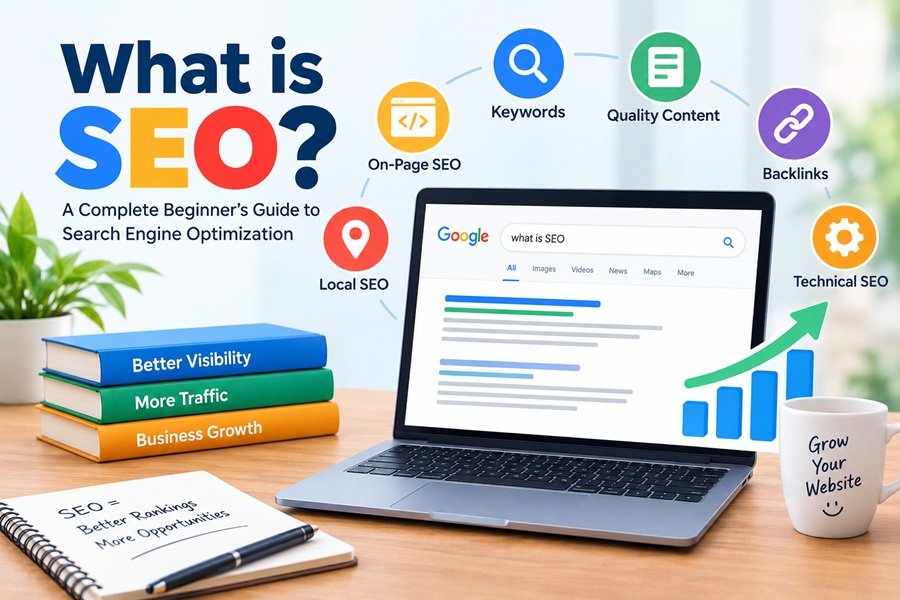
SEO stands for Search Engine Optimization. It is the process of optimizing your website to rank higher in search engines like Google. SEO helps websites gain natural or (unpaid) online visibility, reach their target audience, and attract more visitors.
Search engines like Google are one of the best ways to find information online. Optimizing your site using SEO best practices can help sites answer online queries and reach more people. In this beginner’s guide, you will learn the basics of SEO, how it works, the different types of SEO, and how beginners can get started.
What Is SEO?
SEO (Search Engine Optimization) is the process of improving the online visibility of your website by improving its rankings in the results pages of search engines. Visibility is directly proportional to rankings. Improving rankings using SEO helps the site gain more organic traffic.
A site can become eligible to appear in search results by optimizing the content for the search query using various techniques of SEO.
The purpose of doing SEO is not to game the search results or buy listings. The goal of SEO is to provide the most relevant information to searchers and in turn gain organic traffic.
How Does SEO Work?
Search engines “crawl” the web, find pages, understand what they mean and organize them in a way that is useful and relevant to a user’s question. For example, Google may break a page about sailboats into components and figure out that sailboats are one of the components. That same process is how Google knows a page is about sailboats and may surface it in search results.
There are a few major processes that may occur to a web page in relation to search engines. They are:
1. Crawling
Think about it this way, search engines crawl the web using automated systems (bots), and when those bots come across a new webpage, they read and follow the links to find other pages and content.
2. Indexing
After a search engine crawls and discovers a page, the search engine may try to understand what the page is about. For example, after a page is discovered, the content of that page may be analyzed to determine if it meets requirements to be stored in the search engine’s index.
3. Ranking
After crawling and indexing occurs, search engines may then use various processes and systems to determine what pages to show first to the user.
Generally, the system tries to understand how relevant, useful and quality focused the content is to the user’s question.
SEO tries to answer the user’s question in a relevant and useful way that is clear and accessible, and may help improve its position and relevance to search results.
What is the Benefit of Using SEO?
SEO allows your website to be found by people looking for the information, products and services that your website offers.
Some benefits of SEO are:
Gain more visitors: SEO allows you to gain visitors through organic results.
Become more visible: To be found, a page needs to be optimized.
Earn and build trust: Helpful and relevant content can provide information and thus build trust.
Achieve business growth: Relevant content can help people find your business and build trust.
Retain value: Well-maintained content can provide long term value and earn visitors.
Achieve user experience: Improving a website’s speed, ease of navigation and relevancy can earn trust and provide a positive experience.
It takes time and effort to achieve results through SEO and to continuously improve and maintain them.
What Are the Different Types of SEO?
There are several interconnected aspects of SEO, and improving any one of them can have a positive effect on the others.
1. On-Page SEO
On-Page SEO is improving web page elements to make them more readable and understandable to both search engines and visitors.
- A few important practices of on-page SEO are:
- Using focus keywords naturally in the content.
- Writing clear and descriptive title tags.
- Writing thorough and compelling meta descriptions.
- Using relevant H1, H2, and H3 tags.
- Using descriptive alternative text for images.
- Using inter-page links to related content.
- Writing informative and easy-to-read content.
- Content should be written in a way to effectively answer the search query and answer the questions the reader may have pertaining to the query.
For example, an article targeting the query “What is SEO” should cover the meaning of the term as well as answer related questions.
2. Off-Page SEO
Off-Page SEO focuses on improving a website’s reputation, visibility, and authority off the website.
- A few important off-page SEO practices are:
- Earning relevant and ethical backlinks.
- Writing guest posts for relevant websites.
- Participating in industry-related events and forums.
Sharing helpful content on appropriate social media platforms.
3. Technical SEO
Technical SEO focuses on the structural and technical improvements of a website to help search engines easily crawl, process and index the website’s pages.
- Important elements of technical SEO are:
- Improving website speed.
- Making the website responsive and mobile-friendly.
- Including structured data for search engine results.
- Improving website’s crawl rate.
- Improving XML sitemap.
- Using HTTPS.
- Eliminating broken links and unnecessary redirects.
- Dealing with duplicate content and managing canonical URLs.
- Improving crawlability and indexability.
- Improving website structure.
All the points above come under Technical SEO. This improves search engine accessibility to your content and optimizes website visitor experience.
4. Local SEO
This optimizes the online visibility of a business for users searching for products/services in a specific location.
This is useful for a restaurant, medical clinic, advertising agency, repair service and local shop.
- Some of the local SEO practices are:
- Adequately updating business information on Google Business Profile.
- Adequately updating business information on other local directories.
- Reinforcing a business presence in the local community with local content on business website.
- Building business citations on local directories.
5. Content SEO
his involves creating useful content for the target audience, doing topic and keyword research, analyzing search intent and reworking content if it no longer meets user needs.
- E-A-T
E-A-T refers to the expertise, authoritativeness, and trustworthiness of a content/website.
- User Experience (U.X.)
This creates a usable, friendly and positive website experience.
What are keywords in SEO?
Keywords are phrases and words that someone types into a search engine to find what they are looking for.
An example of keywords that can be used in SEO research is, “what is SEO” or “SEO for beginners” or “how to improve my website ranking” and so on.
When keyword research is conducted, it assists the content creator to understand the interest of their intended audience. The keywords can help content creators come up with different ideas on what to include on their website to help satisfy their audience.
There are different keyword types and they include:
- Short tail keywords are keywords that are broad and not specific like the term SEO.
- Long tail keywords on the other hand are keywords that are detailed and specific. An example is the keyword phrase, “how to do SEO for a new website.”
- There are also, informational keywords which are type of keywords that are used when someone wants to know something. For example “what is SEO.”
- There are also commercial and transactional keywords.
Knowing all these different types of keywords can help you create content that satisfies your intended audience.
Basic SEO Strategies
These are some basic SEO strategies to improve your website visibility if you are a beginner in SEO.
1. Keyword Research
Identify the keywords related to your website, business, or blog and use keyword research tools to come up with potential search queries.
Instead of coming up with a long list of keywords with the highest search volume and blindly incorporating them on your website, do your research and come up with a list of keywords that are most relevant to your audience and content.
2. Create Helpful Content
Write comprehensively and give out details that your audience would need to answer the questions they have. Provide examples, use relevant pictures and include keywords in your content in an understandable manner.
3. Optimize Your Website
Use your keywords to optimize your website by including them in important elements like title tags, meta descriptions, headings, URLs, and alternative text for images, and internal links.
Review each page to confirm the topic is clear to site visitors and the page is useful.
Step 4: Improve Technical SEO
Make sure your site can be seen and accessed by search engines and works well on mobile devices.
Find indexing and technical issues on your site by using Google Search Console.
Step 5: Build Quality Backlinks
Reach out to and develop relationships with leaders in your industry to earn quality backlinks by writing helpful content and posting it on high quality websites.
Use white hat link building strategies. Do not use black hat strategies that violate search engine spam policies.
Step 6: Track Your SEO Performance
Use Google Search Console and compare the information with your analytics to see your site’s performance.
Look at impressions, clicks, search queries, organic visitors and conversions, and use the information to determine ways to improve.
What Is the Difference Between SEO and SEM?
SEO and SEM are digital marketing approaches that can help websites gain visibility in search engines, but they are not exactly the same.
| SEO | SEM |
| Focuses on organic search visibility | Often refers to paid search marketing and may include SEO, depending on the definition |
| Does not require payment for each organic click | Paid campaigns typically involve advertising costs |
| Requires ongoing content and website optimization | Requires campaign setup, budgeting, and management |
| Results can take time to develop | Ads can begin appearing after campaigns are approved |
| Can provide ongoing organic traffic | Paid visibility generally depends on an active campaign |
SEO is focused on improving organic visibility, while paid search advertising allows businesses to pay for placement in sponsored search results.
How Long Does SEO Take to Work?
There’s not a set timeline for SEO. Most sites will see progress within a few weeks, but others could take months.
The main factors impacting the timeline of a site’s progress with SEO are the site’s history, the competition, the quality and quantity of content, any existing technical issues, and the level of commitment to the SEO initiative.
New sites will also take longer to build visibility and search results presence.
Long term maintenance, upkeep, and improvements to technical issues and content are important to improve and maintain search results presence over time.
Avoiding Common SEO Mistakes
Some beginner mistakes limit website performance and include:
- Keyword stuffing: Using the same keyword so often that it makes your content unnatural.
- Duplicate content: Publishing basically the same content more than once.
- Mobile usability: Having a website that is not usable on mobile devices.
- Internal linking: Not making it easy for users to find related content and for search engines to find related pages.
- Buying backlinks: Using link building strategies that violate search engine policies.
- Search intent: Creating content that doesn’t answer the question that users are searching.
- Not monitoring: Not looking over your search visibility, website traffic, or how your website is indexed.
Not avoiding these mistakes can create a better, more sustainable, and helpful website.
Frequently Asked Questions (FAQs)
1. What is the meaning of the term SEO?
Search Engine Optimization (SEO) is the process of optimizing website visibility in the organic search engine results.
2. Is SEO free?
There are no costs involved for clicking on a result in a search engine, but there can be costs for content and technical development.
3. Is it possible to learn SEO by myself?
In theory, the answer is yes. SEO can be learned by first hand practice, as well as through resources available online. It is helpful to have a basic understanding of keywords, content, and the structure of a website.
4. Is SEO relevant for small business?
Small businesses can benefit from SEO in order to make their business more visible to the right audience. Local SEO can benefit small businesses who’s products or services are restricted to a specific location.
5. Will SEO guarantee first page ranking?
There is no way to know for sure where a site will rank. Legitimate SEO specialists will not guarantee rankings.
6. What are the most essential factors of SEO?
Some factors include content, user experience, accessibility, and a trustworthy presence.
Conclusion
SEO is a set of practices that makes it easier for search engines to interpret the contents of your website, and allows people to find relevant information to them, through the organic results of searches.
If you want to improve your website, you should learn about on-page SEO, off-page SEO, technical SEO and local SEO. You should also learn about keyword research.
In order to gain SEO results, it is essential to create valuable content, ensure users experience a good time while navigating your website, and abide by the standards and the regulations of search engines. You should always keep an eye on the performance of your website, and engage in all of this consistently and patiently, and SEO will pay off in your long-term digital marketing strategies.
Read also more : linkelevatemedia
“Cristo si è fermato a Eboli” rimane una lettura fondamentale per chi vuole capire le contraddizioni del progresso e le ferite della storia italiana. Avere il testo in pdf permette di studiarlo con attenzione, cogliendone tutte le sfumature. Noi vi offriamo un percorso di approfondimento che tocca i nodi essenziali dell’opera, dalla magia alla politica. Vi invitiamo a scoprire la potenza di una scrittura che sa denunciare l’ingiustizia con la forza della poesia, lasciandoci un messaggio di solidarietà e di impegno civile che è ancora oggi straordinariamente attuale. https://cristosiefermatoaebolipdf.site/ Carlo Levi Cristo Si È Fermato A Eboli Citazioni
La visione lucida e appassionata di Carlo Levi ci restituisce un’immagine del Mezzogiorno che è entrata nell’immaginario collettivo. La disponibilità del libro in formato pdf è fondamentale per studenti e ricercatori che lavorano su questi temi. Il nostro portale vi guida nello studio dell’opera, offrendo chiavi interpretative originali e rigorose. Vi invitiamo a scoprire come l’autore abbia saputo descrivere la realtà contadina con un rispetto e una profondità rari, creando un libro che è un atto d’accusa contro l’indifferenza e un inno alla dignità di ogni essere umano. https://cristosiefermatoaebolipdf.site/ Carlo Levi Cristo Si È Fermato A Eboli Amazon
In un’epoca di rapidi cambiamenti, rileggere Levi significa fermarsi a riflettere sulle disuguaglianze e sul valore della memoria storica. La disponibilità di versioni digitali come il pdf facilita l’accesso a questo patrimonio culturale inestimabile. Il nostro sito si dedica a esplorare le sfumature di “Cristo si è fermato a Eboli”, offrendo sintesi e commenti che arricchiscono la lettura. Vi invitiamo a scoprire il ritratto vivido che l’autore fa della Lucania, un ritratto che va oltre la superficie per toccare le corde più profonde dell’esistenza umana e della convivenza civile. https://cristosiefermatoaebolipdf.site/ Cristo Si È Fermato A Eboli Riassunto Per Capitoli